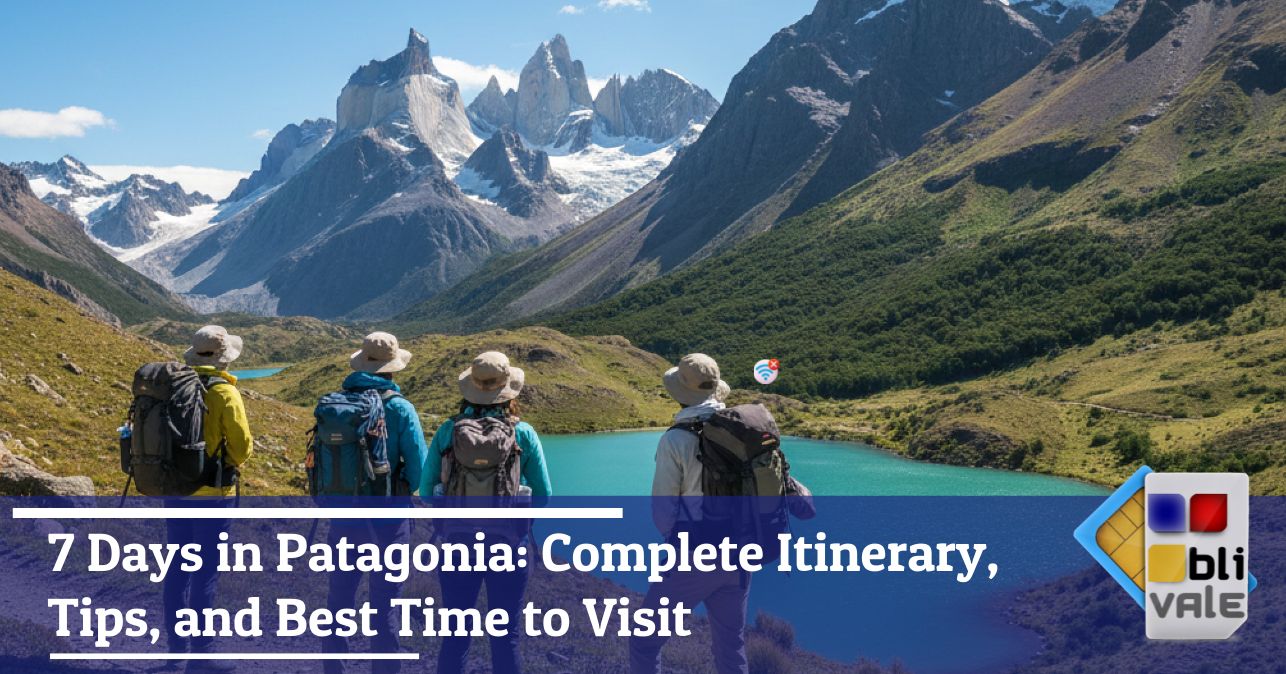
Imagine standing in front of the Perito Moreno Glacier as a block of ice breaks away with a heart-pounding roar. Or walking along windswept trails, surrounded by snow-capped peaks that seem to touch the sky. Argentine Patagonia isn't just a destination: it's a transformative experience, a journey that leaves an indelible mark on the soul of those who visit. If you're planning a week in this land of extreme contrasts, you've come to the right place. This guide will walk you step by step through a streamlined 7-day itinerary, revealing when to go, what to see, and how to stay connected even in the most remote places on the planet.
When to Go to Patagonia: The Best Time for Your Trip
Choosing the right time can make the difference between a memorable trip and one complicated by weather conditions. Argentine Patagonia stretches from the Atlantic Ocean to the Andes, crossing several climate zones that require careful planning.
The southern summer (December to February) is the peak tourist season. Temperatures range between 10°C and 20°C, the days are extremely long with up to 17 hours of daylight, and all trails and services are fully operational. It's the ideal time for those wishing to undertake comprehensive treks like the famous W Circuit in Torres del Paine National Park or venture along the Fitz Roy trails. The only drawbacks are the greater influx of tourists and higher prices.
Autumn (March-May) offers an extraordinary display of colors. The lenga forests are tinged with red, orange, and gold, creating postcard-perfect landscapes. Temperatures drop slightly (5-15°C), but the climate generally remains stable. This period is perfect for those seeking a more intimate experience, with fewer tourists and more affordable rates. Wildlife is also particularly active: guanacos, gray foxes, and condors are easier to spot.
Spring (September-November) marks the awakening of Patagonia. The snow begins to retreat from the peaks, wildflowers bloom in the valleys, and animals emerge from their winter hibernation. Temperatures are cool (5-12°C) but pleasant for hiking. This time of year is ideal for those who want to avoid the summer crowds while enjoying good weather.
The southern winter (June-August) is not recommended for a first trip to Patagonia: many services close, trails are impassable, and temperatures can drop below freezing. However, for the more adventurous, it offers fairytale snowy landscapes and the opportunity to go cross-country skiing.
Practical tip : Regardless of the time of year, the Patagonian wind is constant. It can reach 100 km/h even in summer, so prepare yourself mentally and physically for this unmissable feature of the region.
Why Choose Argentine Patagonia for Your Next Trip
Argentine Patagonia isn't simply a tourist destination: it's a pilgrimage for the soul of adventurers. This extreme territory, often described as "the end of the world," offers something few other destinations can match: the authenticity of the wilderness experience.
Landscapes that redefine natural beauty . Here, nature expresses itself in its most dramatic and spectacular forms. Millennial glaciers slowly advance towards turquoise lakes, granite mountains rising vertically over 3,000 meters, endless windswept steppes where human presence is just a speck on the horizon. Patagonia still retains that primordial energy that the planet's most touristy areas have long since lost.
Biodiversity unlike any other in the world . Despite its apparent harshness, this region is home to incredibly rich ecosystems. Southern right whales, orcas, and Magellanic penguins swim in the cold Atlantic waters. Andean condors, with wingspans exceeding 3 meters, soar above the mountains. Herds of guanacos, the wild cousins of the llama, graze in the steppes. And if you're lucky, you might spot the puma, the undisputed ruler of these lands.
Experiences that change your perspective . Walking for hours without seeing a soul, sleeping in shelters where internet connection is a distant memory, trusting the rhythms of nature rather than the frenetic pace of daily life: Patagonia forces you to slow down, to reconnect with yourself and with what's essential. It's a geographical journey that also becomes an interior one.
Increasing accessibility without losing authenticity . In recent years, the tourism infrastructure has improved significantly. Modern airports connect El Calafate and El Chaltén with Buenos Aires, hotels and hostels of all categories offer comfort even in the most remote areas, and specialized tour operators guarantee safe experiences even for those traveling to wilderness for the first time. All this without distorting the region's wild essence.
An emotional investment worth every penny . Sure, Patagonia isn't the cheapest destination in South America, but every euro spent here returns multiplied in terms of emotions, memories, and that feeling of having truly experienced something extraordinary.
If you are thinking of taking a trip alone or with friends or for work, do not forget the importance of staying connected wherever you are. For unlimited Internet connection, contact BLIVALE where you can get unlimited Internet according to the destinations:
For unlimited plans like data BLIVALE guarantees free roaming anywhere in the world, no additional or hidden costs. Don't let the lack of connection stop you; get ready to explore the world with freedom and spontaneity.
7-Day Itinerary in Argentine Patagonia: A Day-by-Day Guide
A well-planned itinerary is essential to maximizing your Patagonian experience without rushing. Here's the optimized route that balances adventure, relaxation, and wonder.
Day 1: Arrival in El Calafate and First Contact with Patagonia
You land at El Calafate International Airport, the gateway to glacial Patagonia. This town of about 25,000 people overlooks Lake Argentino and is the perfect base for exploring the glaciers.
After checking into your hotel, spend the afternoon taking a relaxing stroll along Avenida del Libertador, the town's main street. Here you'll find outdoor gear shops, traditional restaurants where you can sample the famous cordero patagónico (grilled Patagonian lamb), and agencies where you can book excursions for the following days.
Don't miss Laguna Nimez, a nature reserve just steps from the city center where you can observe pink flamingos, black-necked swans, and ducks in a peaceful setting, with snow-capped mountains as a backdrop. It's the perfect way to get accustomed to the Patagonian atmosphere and prepare for the adventures that await.
Day 2: Perito Moreno Glacier - The Eighth Wonder of the World
Today, one of the most impressive natural spectacles on the planet awaits you. The Perito Moreno Glacier, with its 5-kilometer front and walls up to 70 meters high, is one of the few glaciers in the world still advancing.
Leave early in the morning to reach Los Glaciares National Park (80 km from El Calafate, about an hour and a half by car). Panoramic walkways allow you to admire the glacier from various angles, but the most exciting moment comes when you stand directly in front of the glacial front and witness the collapses: blocks of ice as large as buildings break off with a deafening roar and plummet into the turquoise waters of Lago Argentino.
For an even more intense experience, book a mini ice trek: after a short boat ride, you'll walk with crampons across the glacier's surface, amidst cobalt-blue crevasses and wind-sculpted ice formations. An experience that will make you feel humbled by the power of nature.
Return to El Calafate in the late afternoon. Recharge your batteries with a juicy bife de chorizo paired with a full-bodied Argentine Malbec at a local parrilla.
Day 3: El Chaltén - The Trekking Capital
We wake up early for the transfer to El Chaltén (215 km, about 3 hours by bus). The journey crosses the monotonous but fascinating Patagonian steppe, where herds of guanacos roam freely and the wind bends the shrubs almost to the ground.
El Chaltén is a mountain village founded in the 1980s that today has just 1,500 permanent residents but attracts trekkers from around the world. It is the base for exploring the northern sector of Los Glaciares National Park, home to Mount Fitz Roy (3,405 m) and Cerro Torre (3,128 m), two of the most photographed and sought-after peaks among mountaineers.
After lunch and check-in, enjoy an afternoon walk along the trail to the Mirador de los Cóndores, a short hike (one hour round trip) that offers panoramic views of the town and surrounding mountains. If you're lucky, you'll spot condors soaring on the thermals.
Have dinner at one of the village's mountain huts and get ready: tomorrow, the most beautiful trek of your life awaits you.
Day 4: Trek to Laguna de los Tres - Face to Face with Fitz Roy
Today you'll tackle Patagonia's most iconic trek: the trail to Laguna de los Tres, at the foot of majestic Fitz Roy. Wake up at dawn (around 6:00 a.m.) to maximize your chances of seeing the mountain clear of clouds.
The entire route is approximately 20 km round trip, with an elevation gain of 700 meters, and can be completed in 8-10 hours depending on your pace. The first 10 km pass through lenga forests and open clearings with spectacular views. Then comes the final climb: an hour-long steep ascent over glacial moraines that tests your legs and stamina.
But when you reach the lagoon, all your efforts are rewarded. Fitz Roy rises before you in all its majesty, its granite walls illuminated by the dawn sun, casting golden reflections on the turquoise surface of the glacial lake. It's a moment of pure visual ecstasy that many describe as spiritual.
A picnic lunch on the shore of the lagoon, then a leisurely descent to El Chaltén. By evening, your legs will be tired, but your heart will be filled with uncontainable joy.
Day 5: Trekking to Laguna Torre and Relaxation
Second day of trekking, but more relaxed than the previous one. The trail to Laguna Torre is shorter (18 km total) and less challenging in terms of elevation gain. Departure around 9:00 AM.
The route passes through the Patagonian forest, crosses the Fitz Roy River on suspension bridges, and skirts the lateral moraine to the lagoon. Here, the spectacle is different but equally impressive: Cerro Torre, dubbed by many climbers "the impossible mountain" due to its sheer height and extreme weather conditions, is reflected in the cold waters dotted with floating icebergs that have broken away from the glacier.
If your legs are strong, you can continue for another 30 minutes to the Mirador Maestri, which offers an even better view of the Torres massif. Return to El Chaltén in the afternoon.
Treat yourself to a luxurious dinner at one of the country's finest restaurants: after two days of intense trekking, you'll have earned it. Try the grilled guanaco or Patagonian trout, caught in the area's crystal-clear rivers.
Day 6: Navigation on Lake Viedma and Viedma Glacier
Enjoy a day of active relaxation with a boat trip on Lake Viedma. The cruise takes you to the front of the Viedma Glacier, one of the largest in the region but much less touristy than the Perito Moreno Glacier.
Some excursions offer the chance to walk along the lateral moraine or, for the more adventurous, kayak among the small floating icebergs. The color of the ice here ranges from dazzling white to electric blue, creating a stunning contrast with the intense turquoise of the lake.
Return to El Chaltén in the afternoon. A final tour of the town, souvenir shopping (the local sheep's wool products are excellent), and packing.
Day 7: Return to El Calafate and Departure
Morning bus from El Chaltén to El Calafate. If your return flight is in the afternoon/evening, you'll have time for one last visit to the Glaciarium, the ice museum that uses interactive exhibits to explain the formation of glaciers, climate change, and the importance of these ecosystems for the planet. It also includes an Ice Bar where you can enjoy drinks in glasses made of ice at -10°C.
Transfer to the airport and flight home with a heart full of unforgettable images and the promise of returning.
Culture, Language, and Currency: Practical Information for the Traveller
Understanding the cultural, linguistic, and practical aspects of your destination will help you have a smoother and more authentic experience.
Language : Spanish is the official language in Argentina. In touristy Patagonia, you'll find many people who speak basic English, especially in hotels, restaurants, and travel agencies. However, knowing a few basic Spanish phrases will greatly improve your interactions and will be appreciated by the locals. Useful expressions: "¿Cuánto cuesta?" (How much does it cost?), "¿Dónde está...?" (Where is...?), "Una cerveza, por favor" (A beer, please). Download a translation app that works offline before leaving: in many remote areas, internet connection can be poor.
Currency : The official currency is the Argentine peso (ARS). The exchange rate with the euro is favorable, but Argentina has been experiencing a complex economic climate with high inflation for years. This means prices can fluctuate rapidly. Tip: Change small amounts at a time, use credit/debit cards whenever possible (the commissions are often better than physical exchange), and always carry cash for small purchases and in remote areas where electronic payments are not accepted. ATMs are available in major cities but are scarce in smaller towns.
Local culture and customs : Argentines are generally friendly, talkative, and helpful. Tipping (propina) is appreciated but not mandatory: 10% of the bill is appropriate in restaurants. Meal times are later than in Italy: lunch is from 1:00 PM to 3:00 PM, and dinner rarely before 9:00 PM. Mate, the traditional shared infusion, is a true social ritual: if someone offers you their mate, it's a gesture of welcome and friendship.
Time zone : Argentine Patagonia is 4 hours behind Italy (when it's 12:00 in Italy, it's 8:00 there). It does not observe daylight saving time.
Electricity : Electrical outlets are type C and I (often three-phase), voltage 220V, frequency 50Hz. Bring a universal adapter, although many hotels have multiple outlets.
What to Pack for Patagonia
Packing your backpack or suitcase wisely is essential for navigating Patagonia's changing conditions. The guiding principle is layering, which allows you to quickly adapt to changes in temperature and different activities.
Essential technical clothing :
Breathable thermal base layer (at least 2 sets: one to wear, one as a spare)
Fleece or softshell as a mid-layer
Quality waterproof and windproof jacket (this is the most important purchase: the Patagonian wind is relentless)
Technical trekking trousers, possibly convertible into Bermuda shorts
Waterproof trousers or gaiters to protect from sudden showers
Technical underwear and trekking socks in merino wool (no cotton!)
Visor hat for the sun and wool cap for the cold
Waterproof gloves and neck warmer
Waterproof hiking boots that have already been tested (never wear new shoes in Patagonia!)
Technical equipment :
25-35 litre trekking backpack for day trips
Water bottle or hydration system (at least 1.5 liters capacity)
Telescopic trekking poles (very useful for descending and for crossing streams)
Sunglasses with UV400 protection category 3 or 4
High protection sunscreen (SPF 50+) and lip balm
Power bank to charge your phone and camera
Waterproof bags to protect electronics and documents
Useful accessories :
Binoculars for wildlife observation
Personal first aid kit with blister plasters
Headlamp (the days are long in summer but it can always be useful)
Multipurpose knife
Energy snacks (bars, dried fruit, chocolate)
What to leave at home :
Dress smartly (Patagonia is 100% casual)
Too many changes of clothes (you will wash in the hotel/hostel)
Unnecessary jewelry and valuables
Urban luxury expectations (embrace the adventurous spirit!)
Top tip : Test all your gear before leaving. A leaky jacket, painful boots, or an uncomfortable backpack can ruin the experience. Patagonia doesn't forgive unpreparedness.
Stay Connected Without Worries: BLIVALE's Unlimited eSIM
You've just arrived at Laguna de los Tres after a four-hour trek. Fitz Roy shines before you in all its splendor. You want to share this magical moment with friends and family, search for information on the return trail, check the weather forecast for tomorrow. But your phone has no signal. Zero connection. Total frustration.
This is the reality for many travelers in Patagonia, who rely on local SIM cards with limited bandwidth, expensive international roaming, or hotel WiFi (when it works) for connectivity. But there's a solution that's revolutionizing travel in remote destinations: BLIVALE's eSIM Unlimited .
What it is and how it works : The eSIM is a virtual SIM that activates digitally on your compatible smartphone, without the need for physical cards, store lines, or complicated setup. You shop online before departure, receive a QR code via email, scan it, and you're connected in seconds. Absolute simplicity.
Unlimited Internet, truly unlimited : the feature that makes the difference is the complete absence of GB limits . You can upload all the photos and videos you want to Instagram, reply to work emails, make video calls on WhatsApp, use Google Maps to navigate without worrying about using up data, download offline maps, consult travel guides, book your next hotel, and stream music. In short, you use the Internet exactly as you would at home.
No hidden roaming costs : No nasty surprises when you return. The price is fixed, transparent, and paid in advance. For just €53.70, you get 7 days of unlimited data in Argentina . Keep in mind that a single day of traditional roaming can easily cost €10-15 with ridiculous data limits.
Concrete advantages during the trip :
Instantly share glacier photos on social media
Use real-time translation apps when ordering at restaurants or asking for information.
Access Cloud services for automatic photo and video backup (lose your phone? Your photos are safe)
Book last-minute restaurants, tours, and accommodations
Check the weather conditions in real time before setting off on a trek.
Stay in touch with your loved ones via WhatsApp, Telegram or VoIP calls.
Use Spotify or other music platforms during long bus journeys
Work remotely if necessary (more and more digital nomads are choosing Patagonia)
Reliable coverage : BLIVALE relies on Argentina's main mobile networks, guaranteeing coverage in the main tourist areas of Patagonia. Of course, on the most remote trekking trails, the connection can be lacking (no technology can work miracles in the middle of the mountains), but in hotels, towns, and along main roads, it works perfectly.
Exclusive promotion for readers : Use the code ESIMARGENTINA10 at checkout and get 10% off (valid for 7 days from the publication of this article). Buy your Unlimited eSIM now on BLIVALE Argentina and travel worry-free.
Don't let connectivity issues ruin your Patagonian experience. With BLIVALE's Unlimited eSIM , the freedom to explore meets the security of always being connected.
Conclusions and Final Tips for Your Trip to Patagonia
Argentine Patagonia isn't just a bucket list destination: it's a transformative experience, one that pushes boundaries, one that teaches the value of silence, slowness, and authentic wonder. These seven days will give you memories you'll cherish for a lifetime.
To summarize the key points :
Choose the period between December and March for the best conditions, or March-May for the most intimate experience.
Plan an itinerary that balances intense trekking and recovery days
Invest in quality gear, especially a windbreaker and boots.
Book accommodations and domestic flights in advance (Patagonia is increasingly popular)
Stay connected with BLIVALE's Unlimited eSIM for security and convenience
Final practical tips :
Be flexible: Patagonian weather is unpredictable, sometimes you will have to adapt your plans
Respect nature: stay on marked trails, leave no trace, take your waste away
Listen to your body: trekking at high altitude requires good physical fitness, don't be ashamed to stop if necessary.
Savor every moment: turn off your phone, breathe in the fresh air, really observe what's around you.
Open your heart to the unexpected: often the most beautiful moments are not the ones you planned.
Patagonia awaits you with its millennial glaciers, its imposing peaks, its profound silences. It's neither an easy nor a comfortable journey, but it's a true, powerful, and necessary one. It's the kind of experience that reminds you why it's worth traveling, exploring, and stepping out of your comfort zone.
Pack your backpack, download your eSIM, and let yourself be overwhelmed by the wild beauty of the end of the world. Patagonia isn't for everyone, but for those who choose it, it becomes a forever home.
Ready to go? Start here : secure unlimited data with BLIVALE eSIM for Argentina using the discount code ESIMARGENTINA10 . Your journey begins with just one click.