Why Your eSIM Becomes Useless After 3 Days of Travel
The truth about 128kbps throttling, the myth of "unlimited" internet, and how guaranteed 10Mbps completely transforms the experience of anyone who travels or works remotely.
You've been there too — I'm almost certain of it. Day one of your trip: perfect connection. You send emails, update your maps, watch a YouTube video while waiting to board. Everything works flawlessly. By day two, things start to drag. By day three? Your supposedly "unlimited" eSIM has become, in practice, completely useless.
It's not black magic, it's not the country you're in, and it's not your phone. It's a practice that's widespread among international connectivity providers called throttling — and it represents, when you look at it honestly, the biggest lie in the travel eSIM market.
In this guide, we'll dismantle the unlimited internet myth, walk you through the technical difference between 128kbps and 10Mbps with real data, and show you why BLIVALE chose a different path with its Unlimited Premium line. No impenetrable jargon — just concrete facts that will change the way you choose your next eSIM.
📉 What Is 128kbps Throttling and Why It's a Problem
The term throttling refers to the deliberate practice by a carrier of reducing a user's connection speed after they have consumed a certain amount of high-speed data. In other words: they give you a fast lane for the first few gigabytes, then push you onto the hard shoulder for the rest of your trip.
The Fair Usage Policy (FUP): the contract within the contract
Nearly every international eSIM provider buries a clause called the Fair Usage Policy — or FUP — in their terms and conditions. It's the clause that, in technical language, authorises the operator to "manage the network" by reducing your speed once you've passed a threshold of priority data.
The typical threshold before throttling kicks in varies from provider to provider: it might be 500MB, 1GB, 3GB, or even 5GB. After that, your speed is slashed — often dramatically — down to 128kbps. This number, seemingly just a technical figure, hides a brutal reality that we'll break down in the next section.
What happens to your data packets during throttling
When bandwidth is throttled, the carrier's router applies a technique called traffic shaping. Essentially, every data packet your smartphone sends or receives is queued, slowed down, and released in a trickle. The result? The connection remains technically active — you can still see signal bars on your screen — but the flow of data has been reduced to a crawl.
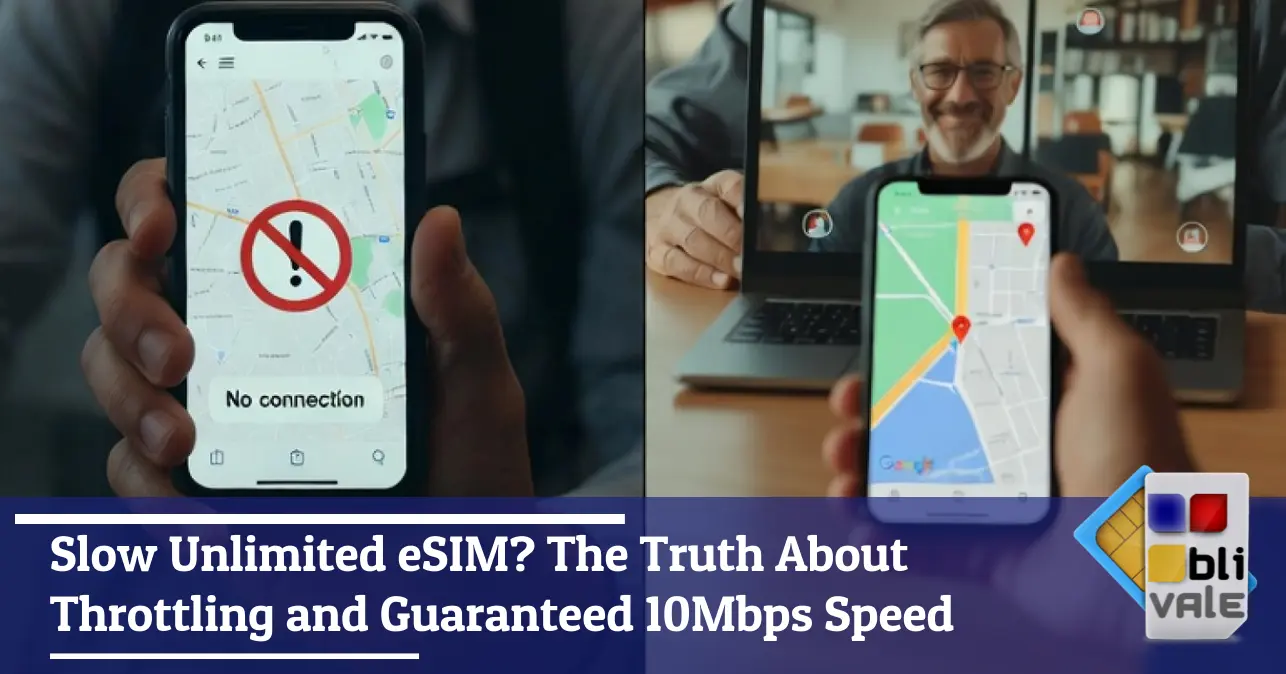
Practical example: loading your position on Google Maps normally takes less than a second. With 128kbps throttling, that same action can take 10 to 15 seconds. If you're in an unfamiliar area, searching for an urgent address, or waiting for a taxi with your app open — those seconds become a genuine problem.
⚡ 128kbps vs 10Mbps: The Ultimate Test
Let's talk numbers. 128 kilobits per second versus 10 megabits per second. The difference isn't linear — it's astronomical. 10Mbps is roughly 78 times faster than 128kbps. But raw speed alone doesn't tell the full story: what really matters is the minimum threshold for each digital task to work at all.
10Mbps = approximately 78× the speed of 128kbps
- ✉️ Plain text emails (no attachments) — slow
- 🗺️ Google Maps — freezes, fails to load
- 📸 Instagram / photos — upload fails
- 🎥 Netflix / YouTube — impossible
- 📞 WhatsApp video — constant buffering
- 💼 Zoom / Meet — completely unusable
- ☁️ Cloud / Google Drive — timeout errors
- ✅ Emails with large attachments
- ✅ Google Maps smooth in real time
- ✅ Instagram, TikTok, instant photo uploads
- ✅ Netflix / YouTube SD/HD without interruptions
- ✅ WhatsApp video and HD calls
- ✅ Zoom, Meet, Teams — great quality
- ✅ Cloud uploads/downloads without issues
The critical threshold for basic browsing sits around 256kbps. Video streaming requires at least 3Mbps (SD) or 5Mbps (HD). Stable video calls need 1.5–2Mbps at a minimum, though 5Mbps is the comfortable safety margin. BLIVALE's guaranteed 10Mbps covers all of these scenarios with room to spare — even if you're sharing the connection via hotspot with other devices.
The tasks where 128kbps will always fail you
🚀 The BLIVALE Unlimited Premium Revolution: Guaranteed 10Mbps
When we built the BLIVALE Unlimited Premium line, we asked ourselves a simple but uncomfortable question: how many of the "unlimited" eSIMs on the market are actually usable throughout an entire trip? The answer convinced us to take a different road.
The choice of 10Mbps as the guaranteed minimum speed isn't arbitrary. It's the result of a thorough analysis of the real needs of travellers in 2026: remote professionals, digital nomads, families on holiday, entrepreneurs on business trips. All of them with a smartphone in hand, a calendar packed with video calls, and a legitimate dependency on maps and apps.
Why we chose exactly 10Mbps
10Mbps represents the real universal usage threshold: it's the minimum level that simultaneously enables smooth web browsing, standard-quality video streaming, stable video conferencing, and full use of all major messaging and productivity apps. It's a concrete, verifiable, measurable number — not a marketing claim.
Benefits for Remote Work on the Road
Anyone who works remotely knows how critical connection quality is during a video call with an important client. With guaranteed 10Mbps, you can comfortably handle:
Video calls on Zoom, Google Meet, Microsoft Teams — stable HD quality, no freezing, no audio drop-outs.
Screen sharing and presentations — instant file loading, no more "hold on, it's still buffering".
Cloud uploads (Drive, Dropbox, OneDrive) — large files transferred in reasonable time.
Hotspot tethering for laptop or tablet — the Premium line supports tethering: share your connection with other devices without significant speed loss.
Benefits for Leisure Travellers
Not travelling for work? No problem. 10Mbps radically transforms the tourist experience too:
Google Maps and Waze in real time — no lag even in the most congested city centres.
Netflix, Disney+, Prime Video — SD/HD streaming without buffering, perfect for long transfers and layovers.
Instant sharing of photos and videos — posting to Instagram or sending a family video becomes a matter of seconds.
Last-minute bookings — Booking.com, Airbnb, OpenTable: no waiting, no timeout errors.
🔍 How to Check the Real Speed of Your eSIM
The good news is that checking the actual speed of your roaming connection is straightforward and free. The bad news is that many providers do everything they can to discourage you from doing it — or simply don't explain how to interpret the results correctly.
Recommended tools
The most reliable and universally recognised tool is Speedtest by Ookla (speedtest.net), available as a mobile app (iOS and Android) and as a web version. To run a proper test while roaming, follow these steps:
Turn off Wi-Fi before running the test — make sure you're measuring your eSIM data connection, not the hotel's network.
Select a nearby server — choose a server in the country you're in, rather than the automatic server which might connect to a distant data centre.
Run the test 3 times at different times of day — results vary depending on network load during peak hours.
Note the ping (latency) as well as the speed — a ping below 100ms is acceptable for video calls; below 50ms is excellent.
How to interpret your results while roaming
In international roaming environments, speedtest results are influenced by several factors: the quality of the roaming agreement between your provider and the local carrier, the number of network hops between the country you're in and the internet exit point, and the time of day. If you measure less than 1Mbps on download, you're almost certainly already being throttled — regardless of how many GB the user dashboard says you have left.
❓ FAQ — Frequently Asked Questions About eSIM Speed
What does "guaranteed minimum speed" actually mean?
Can I watch Netflix with guaranteed 10Mbps?
Does the priority data limit reset daily or monthly?
Can I use hotspot (tethering) with the Premium line?
Does throttling depend on the country I'm in?
How do I upgrade to the Unlimited Premium plan?
🎯 Conclusion: Don't Get Stranded Mid-Trip
Let's be honest: the eSIM market is full of offers that sound incredible until you actually try to use them in the field. "Unlimited data" has become a meaningless phrase when most providers pair it with 128kbps throttling — a speed that technically belongs to the era of 56k dial-up modems, not 2026.
The real question to ask before buying an international eSIM isn't "how many GB do I get?" — it's "what's the minimum speed I can count on for the whole trip?" The answer to that question changes everything: the provider you choose, your expectations on the road, and the quality of your digital life away from home.
BLIVALE has chosen the path of technical transparency: stating the guaranteed minimum speed clearly, with no hidden asterisks, no nasty surprises on day three. Not because it's the easiest commercial choice — but because it's the right one for anyone who trusts us to keep them connected while they work, travel, or explore the world.
Travelling, in transit, or planning your next trip?
There are international connectivity solutions designed exactly for professionals and travellers like you — activatable in 2 minutes, operational in over 200 countries, with no long-term contracts and no throttling surprises at the worst possible moment.
Explore connectivity solutions →Instant eSIM · No contracts · Guaranteed 10Mbps · 200+ countries